
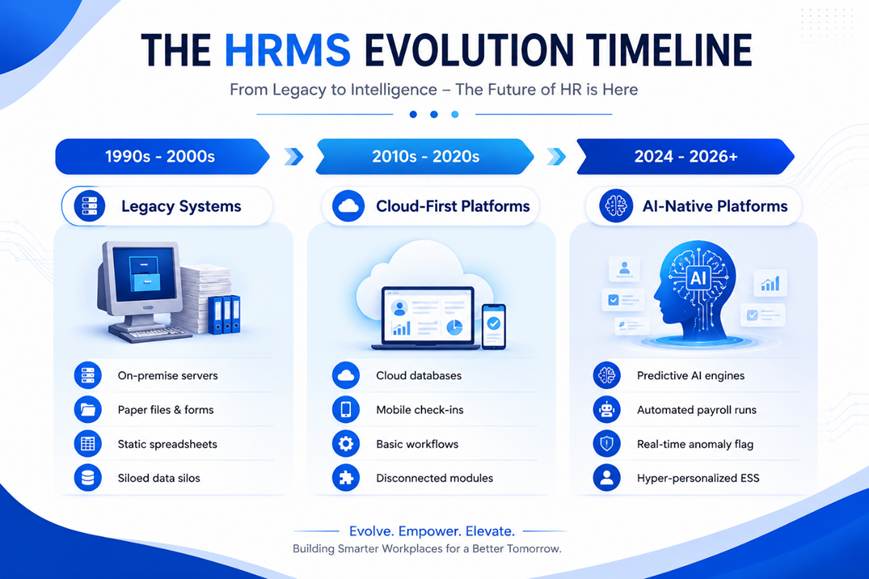
Human resource management is undergoing its most profound structural shift since the advent of enterprise cloud computing. For decades, Human Resource Management Systems (HRMS) functioned as passive digital filing cabinets—systems of record designed primarily to store personal identification details, log timestamps, generate basic payslips, and archive compliance documents.
However, the traditional model has hit a hard operational ceiling. Modern organizations face distributed teams, hybrid schedules, intricate statutory compliance mandates, and heightened expectations for workplace culture. Passive databases can no longer keep up. HR teams find themselves buried under repetitive administrative tickets, manual spreadsheet reconciliations, delayed leave approvals, and fragmented employee communications.
Artificial Intelligence (AI) and automated workflow engines are turning HR software into an active system of intelligence. Rather than merely recording historical data, an intelligent platform predicts workforce trends, eliminates operational bottlenecks, automates high-stakes calculations, and personalizes the workplace journey.
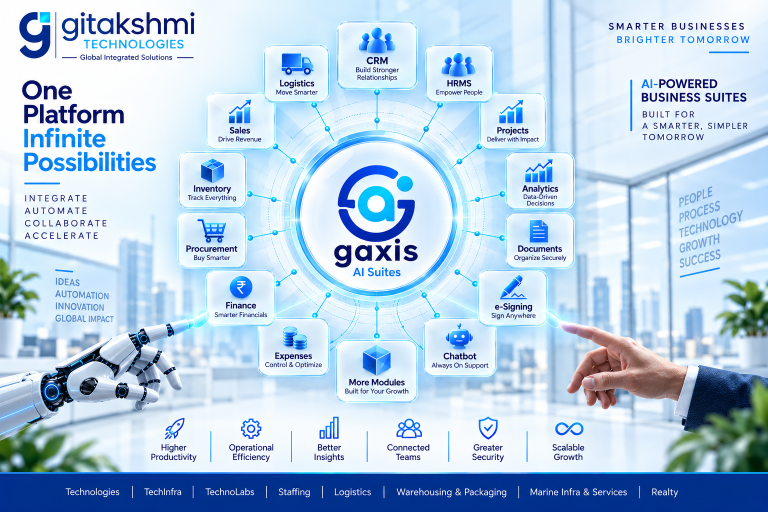
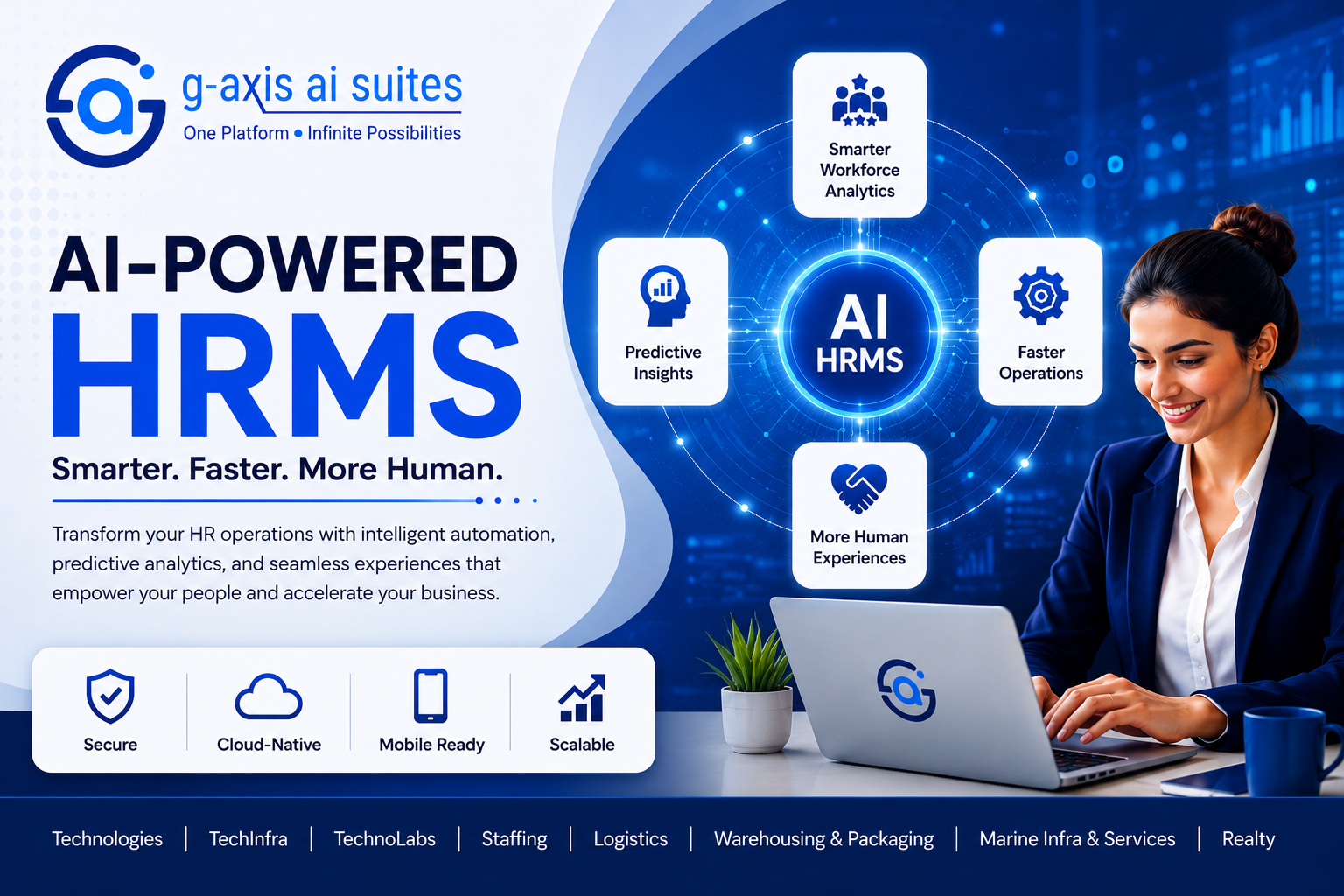
This comprehensive guide examines how artificial intelligence is transforming modern workforce technology across three core pillars—Smarter Analytics, Faster Operations, and More Human Experiences—and how g-HRMS (powered by the g-Axis AI Suite) provides the scalable architecture organizations need to build high-performance, employee-centric workplaces.
1.The Friction in Traditional HR Management
Historically, HR departments spent up to 60–70% of their working hours on tactical, low-value administrative overhead:
- Spreadsheet Fragmentation: Employee data scattered across attendance software, leave trackers, biometric machines, and payroll sheets.
- Payroll Vulnerabilities: Manual formulas, human calculation errors, tax deduction oversights, and retroactive adjustments
- Approval Bottlenecks: Leave applications, travel reimbursements, and asset allocations stuck in multi-tier email loops.
- Reactive Talent Management: Discovering employee dissatisfaction or impending resignations only after an exit interview is booked.
g-Axis AI Suite bridges this gap. With g-HRMS functioning as its specialized workforce engine, the suite delivers enterprise-grade speed, native AI-driven automation, unified single sign-on (SSO) architecture, and intuitive design—delivering high power without unnecessary operational complexity.
2. Smarter HRMS – Predictive Intelligence & Workforce Analytics
The first major transformation AI brings to human resources is the transition from descriptive reporting (what happened in the past) to predictive analytics (what will happen next and what action should be taken).
2.1 Proactive Attrition Risk Detection
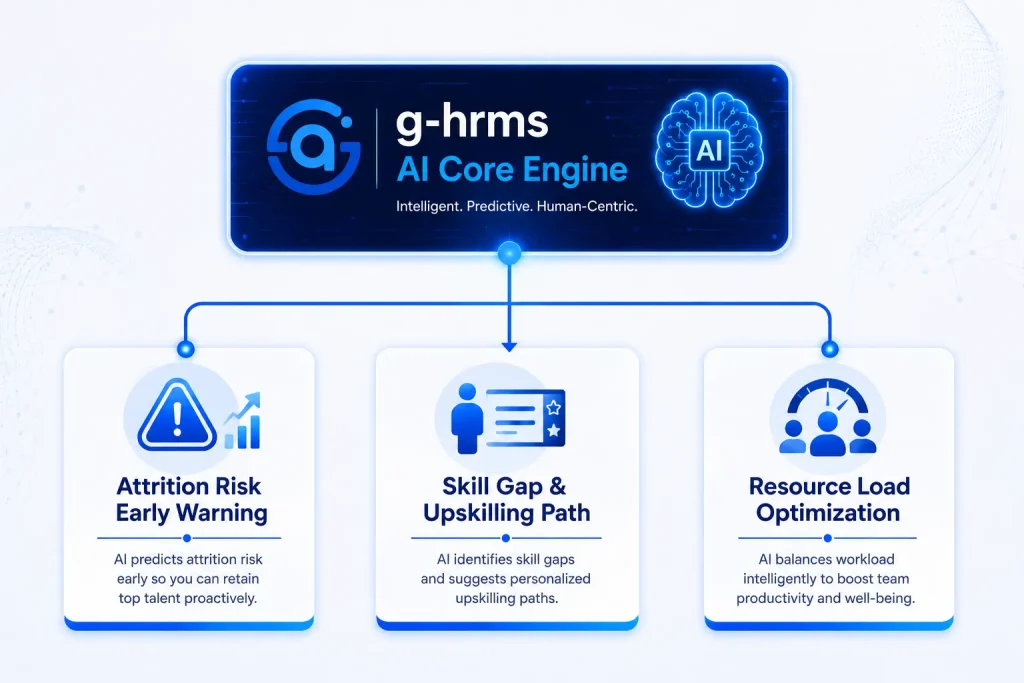
Traditional systems record an employee’s departure after the resignation letter arrives. AI-enabled platforms monitor multi-dimensional operational signals to detect burnout and disengagement early:
- Anomalies in attendance patterns (e.g., sudden frequent partial-day leaves).
- Sharp drops in peer recognition, internal collaboration, or goal-updating frequency.
- Prolonged stagnation in role advancement or skill utilization.
How g-Axis AI Suite Executes: Leveraging cross-app intelligence, g-HRMS aggregates anonymized engagement and operational signals, alerting HR business partners with risk scores so managers can conduct supportive 1-on-1 check-ins before top talent exits.
2.2 Intelligent Skill Gap & Workforce Planning
As business requirements pivot rapidly, companies must know whether their current workforce possess the technical capabilities needed for upcoming projects.
- Automated Competency Mapping: Parsing employee project histories, certifications, and performance reviews into an interconnected skills graph.
- Tailored Upskilling Recommendations: Suggesting targeted training modules based on individual career aspirations and organizational demands.
2.3 Headcount & Resource Forecasting
Rather than guessing staffing requirements for the next quarter, the predictive models within g-Axis AI Suite analyze project workloads, seasonal turnover rates, and pipeline demand inside g-HRMS to forecast optimal departmental headcounts, preventing both under-staffing bottlenecks and over-hiring overhead.
3. Faster HRMS – Autonomous Operations & Zero-Friction Workflows
Speed in HR operations is directly linked to operational trust. When payroll processing is delayed or leave approvals take days, employee confidence erodes. AI removes administrative lag through intelligent automation.
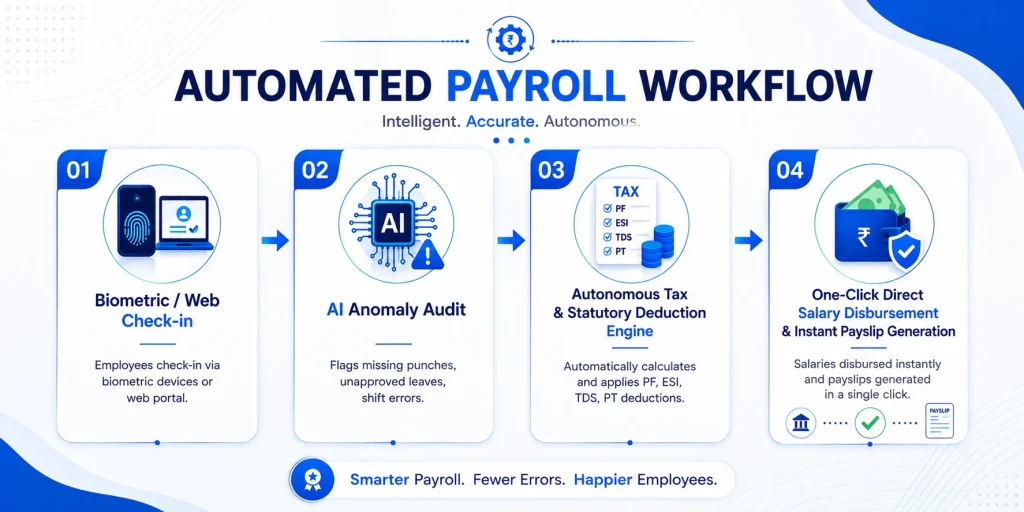
3.1 Real-Time Attendance & Anomaly Auditing
Biometric hardware, geo-tagged mobile check-ins, and flexible hybrid schedules generate millions of timestamp logs.
- The Manual Bottleneck: HR spends days at month-end cross-checking missed punches, half-day leaves, shift allowances, and overtime logs.
- The AI Solution in g-HRMS: Instantaneous validation algorithms continuously audit daily attendance. If an employee forgets to clock out or a mismatch occurs between rostered shifts and physical access logs, the system triggers automated confirmation prompts to the employee and manager immediately.
3.2 One-Click Automated Payroll & Statutory Compliance
Payroll is a mission-critical operation where zero error is tolerated.
- Statutory Accuracy: Dynamic computation of Provident Fund (PF), Employee State Insurance (ESI), Professional Tax (PT), Tax Deducted at Source (TDS), and variable performance bonuses.
- Proactive Pre-Payroll Validation: Before execution, g-hrms runs automated pre-flight checks, flagging discrepancies such as negative salary conditions, duplicate bank accounts, or missing tax declarations.
3.3 Instantaneous Tier-1 Employee Query Resolution
A massive volume of daily HR support tickets involves routine operational questions:
- “How many privilege leaves do I have left?”
- “Where can I download my Form 16 or latest payslip?”
- “What is our company’s medical insurance policy coverage for dependents?”
Integrated conversational AI assistants within the g-Axis AI Suite resolve these inquiries in real-time, pulling directly from verified company policy repositories inside g-HRMS while preserving strict confidentiality.
4.More Human – Hyper-Personalized Employee Experience
The most common misconception regarding AI in human resource management is that automation creates a sterile, impersonal corporate environment. In reality, modern AI eliminates bureaucratic friction, enabling organizations to be significantly more human.
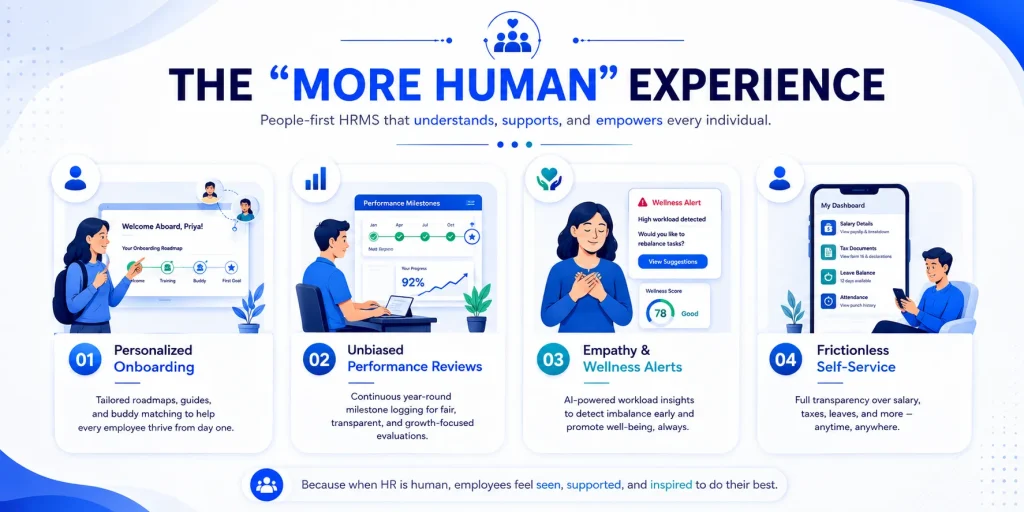
4.1 Frictionless, Adaptive Onboarding Journeys
A new hire’s first week sets the tone for their entire tenure. Instead of dumping a stack of static policy PDFs and manual paperwork on day one:
- g-hrms curates an interactive, personalized onboarding checklist tailored to the hire’s department, seniority level, and technical stack.
- Automated provisioning of digital tool accesses, introduction schedules with team mentors, and interactive document uploads via self-service portals.
4.2 Eliminating Bias in Performance Management & Appraisals
Traditional annual appraisal cycles suffer from severe cognitive pitfalls:
- Recency Bias: Managers over-weighting achievements or mistakes that occurred in the last four weeks while ignoring work done ten months prior.
- Central Tendency & Halo Effects: Inconsistent evaluation criteria across departments.
AI-assisted appraisal systems within g-hrms consolidate quantifiable milestones, peer kudos, project delivery metrics, and goal completion rates throughout the entire 365-day cycle. This provides managers with objective, comprehensive performance
summaries, leading to fairer appraisals, equitable promotions, and transparent merit cycles.
4.3 Employee Well-being and Work-Life Harmony
By observing systemic overtime patterns, unused leave accumulation, and late-night logging habits across teams, g-Axis AI Suite alerts leadership to potential structural imbalances. Managers can proactively redistribute project workloads before team members face severe exhaustion.
5. Architectural Deep-Dive: Core Modules of g-HRMS
Sitting within the broader g-Axis AI Suite, g-HRMS provides a robust, end-to-end modular architecture designed to handle every phase of the employee lifecycle:
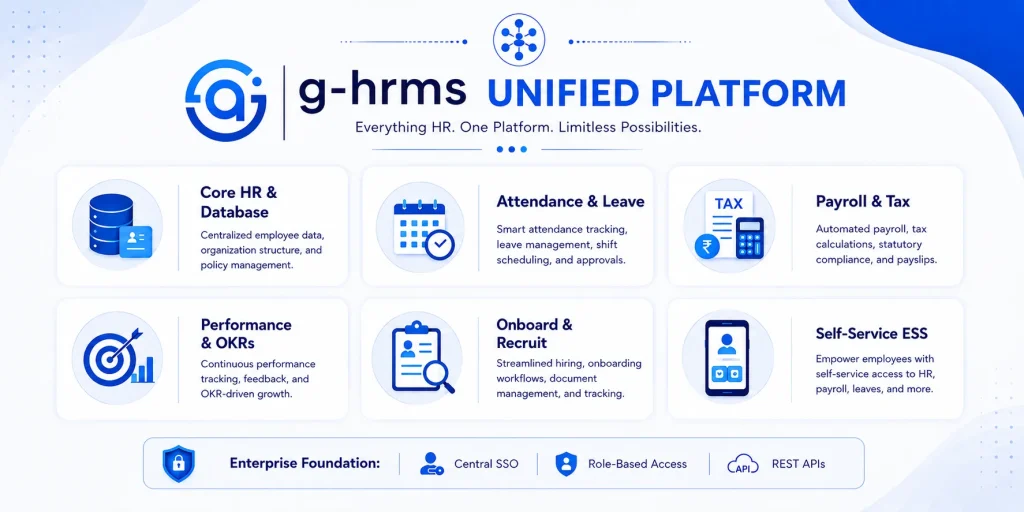
5.1 Centralized Employee Core Database
- Single Source of Truth: Secure digital storage for employee profiles, identification records, emergency contacts, organizational hierarchies, and salary structures.
- Role-Based Access Control (RBAC): Granular permissions ensuring managers, HR personnel, and employees view only the specific data layers authorized for their role.
5.2 Smart Time, Attendance & Shift Engine
- Multi-Channel Punch Ingest: Support for biometric hardware integration, geo-fenced mobile punches, and desktop single-click web clock-ins.
- Dynamic Shift Management: Effortless configuration of rotational shifts, night allowances, grace periods, flexible working windows, and weekend rules.
- Comprehensive Leave Management: Transparent leave balances, compensatory-off tracking, automated accruals, and instant multi-level approval workflows.
5.3 Automated Indian & Global Payroll Engine
- Full Statutory Compliance: Pre-configured rules for PF, ESI, Professional Tax (state-wise), LWF, and automated TDS tax slabs (New vs. Old regime).
- Flexible Reimbursements & Perks: Configurable heads for fuel, internet, medical, and special allowances with digital receipt submission and instant audit trails.
- Direct Bank Batch Files: Automated generation of bank-ready payout files for one-click disbursement across major banking institutions.
5.4 Performance, OKR, and Continuous Feedback Hub
- Flexible Review Methodologies: Support for OKRs (Objectives and Key Results), KPIs, 180-degree, and 360-degree feedback reviews.
- Continuous Check-ins: Structured 1-on-1 meeting templates, sprint goal alignments, and ongoing achievement tracking.
5.5 Recruitment & Applicant Tracking System (ATS)
- Job Requisition & Multi-Board Posting: Create hiring requisitions, manage approval chains, and publish openings seamlessly.
- Resume Parsing & Candidate Scoring: AI-assisted parsing extracts relevant skill metrics, indexing candidate resumes directly into structured candidate profiles.
5.6 Comprehensive Employee Self-Service (ESS) Portal & Mobile App
- Instant mobile and desktop access for team members to download salary slips, submit expense reports, declare investment proofs, view holiday calendars, and request leaves without needing direct HR intervention.
6.Enterprise Security, Multi-Tenancy, and Single Sign-On (SSO) Architecture
When implementing a central system of intelligence, data privacy and infrastructure security are paramount.
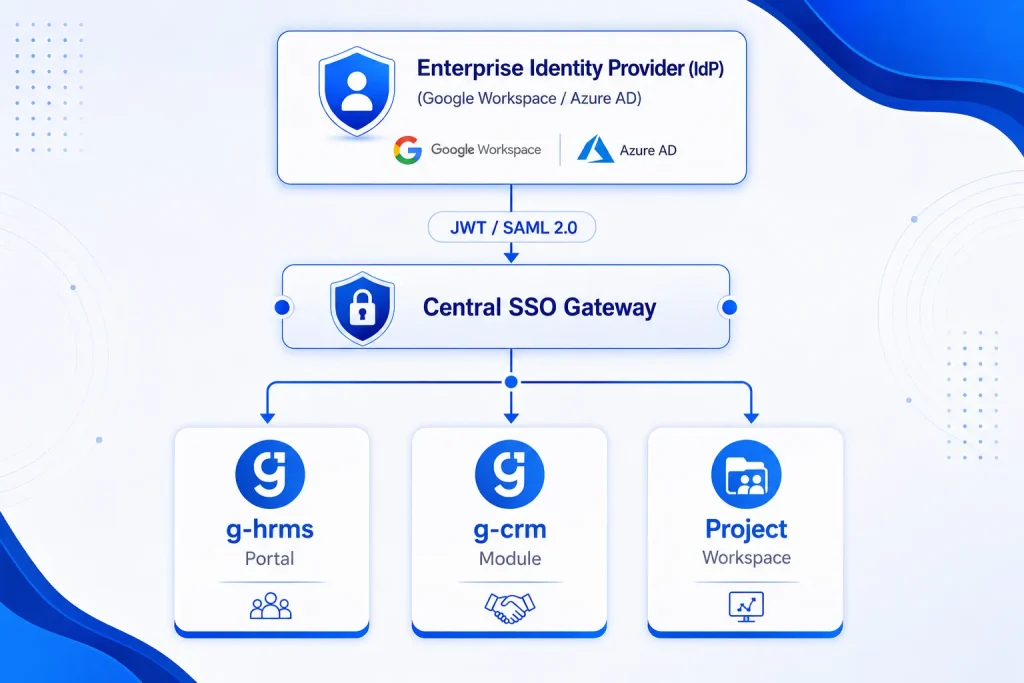
6.1 Centralized Identity & Single Sign-On (SSO)
Managing disparate passwords across internal platforms (HRMS, CRM, project boards) introduces severe security vulnerabilities.
- The g-Axis AI Suite implements secure, centralized Single Sign-On (SSO) across all its enterprise apps (including g-HRMS, CRM, and Project Management) utilizing JWT token exchange and industry-standard SAML 2.0 / OAuth2 authentication protocols.
- One unified corporate credential gives employees seamless access to their authorized enterprise workspace, while admins maintain instant one-click onboarding and offboarding access revocation.
6.2 Data Encryption & Granular Privacy
- Encryption Standards: Full end-to-end data encryption in transit (TLS 1.3) and at rest (AES-256) ensures that sensitive compensation details and identity records remain completely secure.
- Strict Multi-Tenant Isolation: Database architecture guarantees complete, secure tenant segregation with zero risk of cross-tenant data leakage.
7. Step-by-Step Implementation & Migration Roadmap
Transitioning your workforce from manual spreadsheets or an outdated legacy platform to g-hrms follows a clear, structured 4-phase methodology:
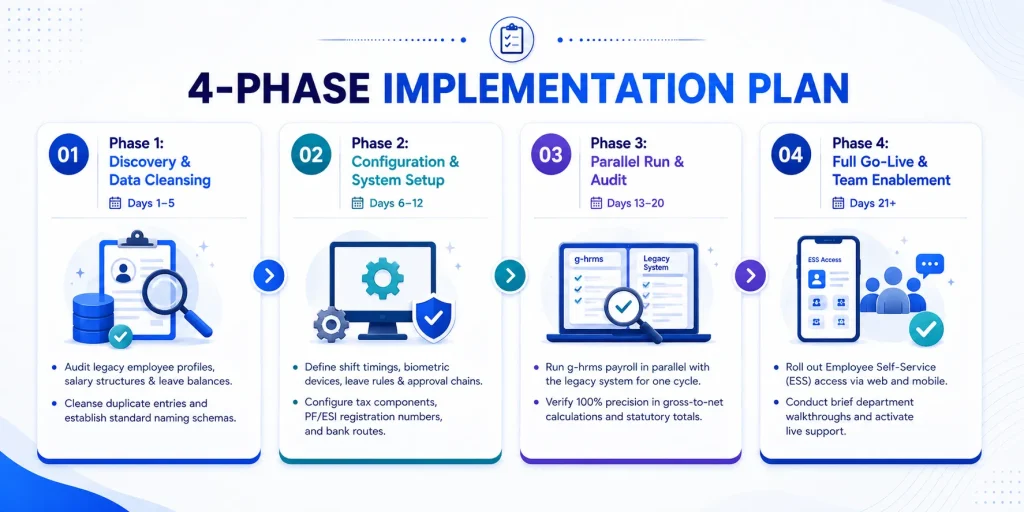
- Phase 1: Discovery & Architecture Mapping: Audit of current workforce data, custom shift policies, and statutory configurations.
- Phase 2: Secure Migration & Integration: Clean bulk data import into the g-Axis AI Suite database and hardware API setup for biometrics.
- Phase 3: Sandbox Validation & Parallel Payroll Run: Executing a side-by-side payroll run to confirm 100% calculation accuracy against legacy outputs.
- Phase 4: Enterprise Rollout & Training: Launch of the ESS mobile app, SSO onboarding, and automated stakeholder training.
8. Measuring Tangible ROI: The Business Case for g-hrms
Deploying g-HRMS within the g-Axis AI Suite delivers quantifiable operational and financial returns:
- 80% Reduction in Payroll Processing Cycles: Transform multi-day manual spreadsheet crunching into a streamlined, audited 15-minute execution.
- Zero Statutory Non-Compliance Penalties: Built-in validation rules eliminate late filing calculations and deduction discrepancies.
- 65% Drop in Routine HR Tickets: Self-service portals empower team members to access payslips, leave balances, and tax documents independently.
- Improved Employee Retention: Proactive burnout alerts and objective performance management foster transparency and workplace trust.
9. Frequently Asked Questions (FAQs)
Q1: What makes an AI-powered HRMS different from standard cloud HR software?
Standard cloud HR software acts primarily as a digital database to store employee information and record timestamps. An AI-powered HRMS actively audits data in real-time, predicts talent attrition risks, automates complex calculations like payroll anomalies, and resolves routine employee queries automatically.
Q2: How does g-hrms ensure accurate payroll and statutory compliance?
g-hrms features a dynamic tax and deduction engine pre-configured for national and state regulations (including PF, ESI, Professional Tax, and dual tax regimes). It runs automated pre-flight anomaly audits prior to payout execution, ensuring calculations are 100% compliant and error-free.
Q3: Can g-hrms integrate with our existing biometric attendance machines?
Yes. g-hrms provides multi-channel attendance synchronization, supporting direct biometric hardware APIs, geo-fenced mobile check-ins, and secure web-based clock-in portals.
Q4: Is our employee compensation and personal data secure on g-hrms?
Absolutely. g-hrms employs enterprise-grade AES-256 encryption at rest, TLS 1.3 encryption in transit, strict multi-tenant data isolation, role-based access controls, and Single Sign-On (SSO) authentication.
Q5: How long does it take to migrate from Excel or our legacy system to g-hrms?
Most mid-market organizations complete full data migration, system configuration, and user rollout in under 2 to 3 weeks using our standardized 4-phase onboarding framework.
10. Conclusion & Next Steps
Workplace dynamics have changed permanently. Organizations that rely on fragmented spreadsheets and outdated legacy tools burden their HR teams with administrative burnout and risk costly compliance errors. By harnessing artificial intelligence, modern platforms transform HR into a high-speed, proactive growth engine. g-hrms brings this future to life today—delivering the predictive intelligence to make smarter decisions, the autonomous automation to execute faster, and the transparency to build a more human workplace.
By harnessing artificial intelligence, modern platforms transform HR into a high-speed, proactive growth engine. The g-Axis AI Suite and its core g-HRMS engine bring this future to life today—delivering the predictive intelligence to make smarter decisions, the autonomous automation to execute faster, and the transparency to build a more human workplace.