
The Modern Enterprise Operating System
In today’s hyper-competitive digital economy, speed, visibility, and agility are not just operational goals—they are existential necessities. Yet, the vast majority of medium and large organizations run their mission-critical business processes on a fragmented patchwork of point solutions.
HR operates in one tool. Sales negotiates in another. Projects are planned in standalone software, while procurement, expenses, vendor contracts, and asset lifecycle data live in detached spreadsheets or legacy on-premise silos.
The outcome? Data blind spots, sluggish cross-departmental handoffs, spiraling license subscription bills, and leadership teams forced to make reactive decisions based on week-old reporting.
g-axis suites, engineered and backed by Gitakshmi Technologies, was built to solve this exact problem.
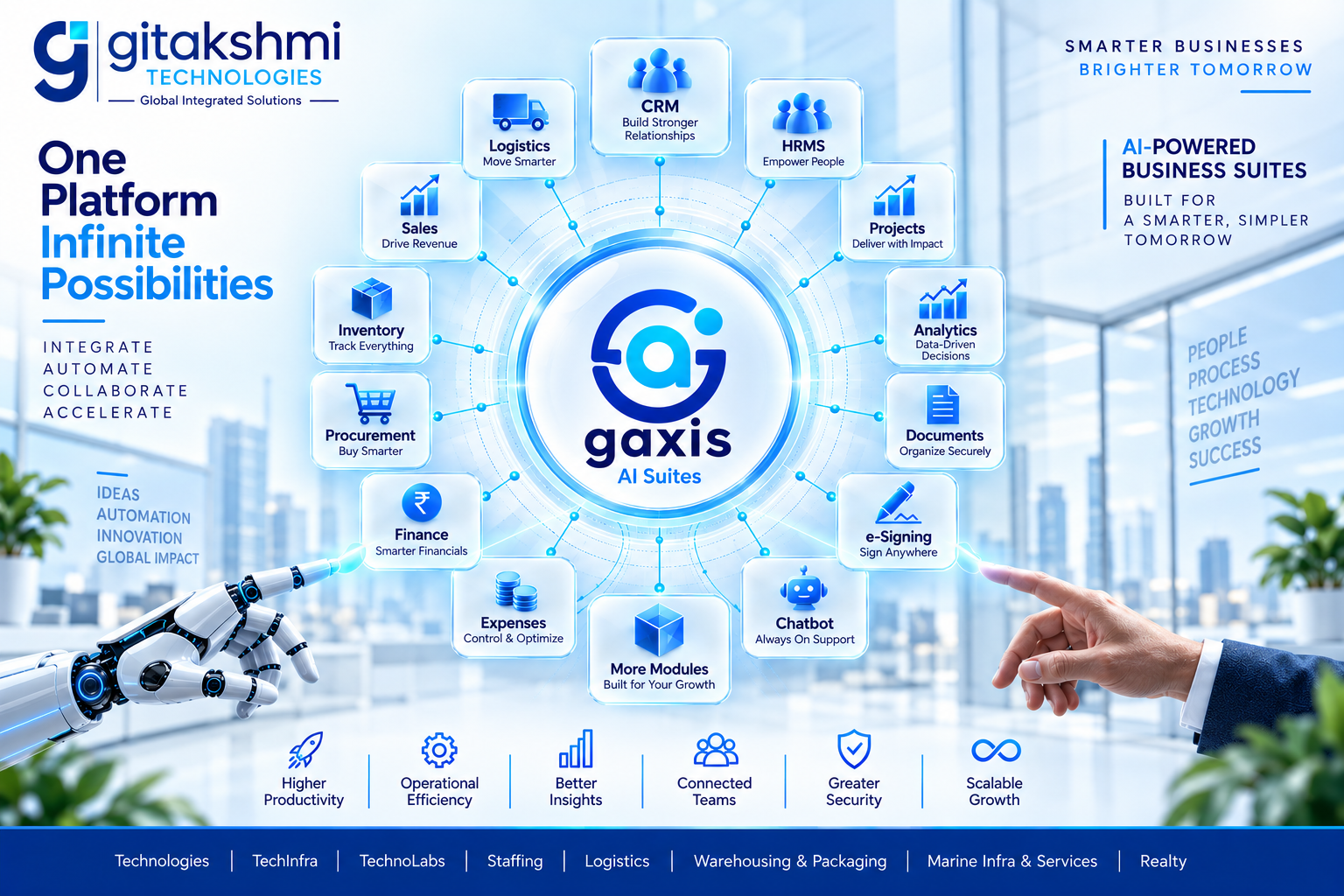
Operating under the philosophy of “One Platform • Infinite Possibilities,” g-axis suites is not merely another HRMS or a standalone CRM. It is a comprehensive, cloud-native SaaS ecosystem comprising 14 deeply interconnected business products powered by one unified data model, one unified login, and a centralized, 100% role-based security framework.
This guide explores the architectural, operational, and financial realities of fragmented enterprise tools, breaks down every single product module inside g-axis suites, and details the sprint-based deployment framework engineered to de-risk your digital transformation.
1. The Anatomy of Modern Operational Bottlenecks
Before exploring how consolidation creates business value, we must examine the hidden operational tax paid daily by organizations running disconnected enterprise software stacks.
1.1 The Pain of Fragmented Systems
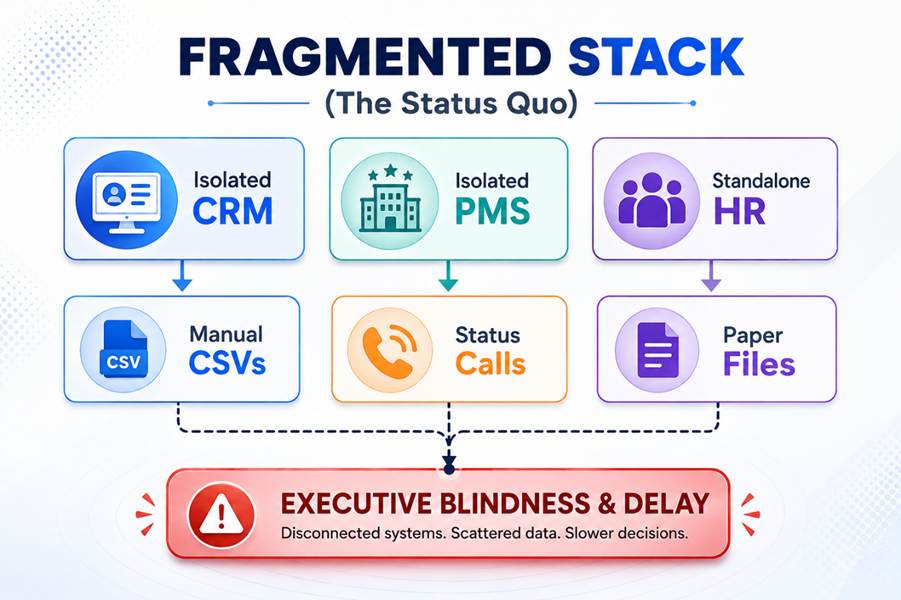
When recruitment runs on Platform A, daily biometric attendance on Platform B, monthly payroll on Platform C, and client milestones on Platform D, no department possesses a single source of truth. Data synchronization between systems requires fragile custom APIs, manual CSV export/import routines, or constant third-party middleware configurations. When an employee switches projects or leaves the organization, IT administrators must manually revoke permissions across half a dozen dashboards, introducing severe security vulnerabilities.
1.2 Spreadsheet Sprawl & Manual Human Error
Spreadsheets are flexible for individuals but disastrous for scalable enterprises. Organizations stitch together month-end billing, resource utilization metrics, and physical asset verifications by hand. A single missing formula or outdated column in an Excel sheet leads to inaccurate payroll calculations, missed project billables, or regulatory compliance penalties.
1.3 Poor Visibility and Offline Approval Queues
How long does it take for a capital purchase order, a travel expense claim, or an NDA to be approved in your organization? In disconnected environments, approval workflows depend on untracked email chains, instant messaging pings, or physical paper signatures. Decisions that should take four minutes take four days, stalling project momentum and frustrating both clients and employees.
1.4 Delayed Executive Steering
Enterprise leadership cannot steer proactively if core metrics are delivered retrospectively. When monthly financial and delivery reports take 15 days to compile after month-end, executives are driving looking solely through the rearview mirror. Modern business demands real-time dashboards that reflect actual project velocity, cash outflow, sales pipeline health, and workforce allocation at any given minute.
2. Introducing g-axis suites: One Platform, Infinite Possibilities
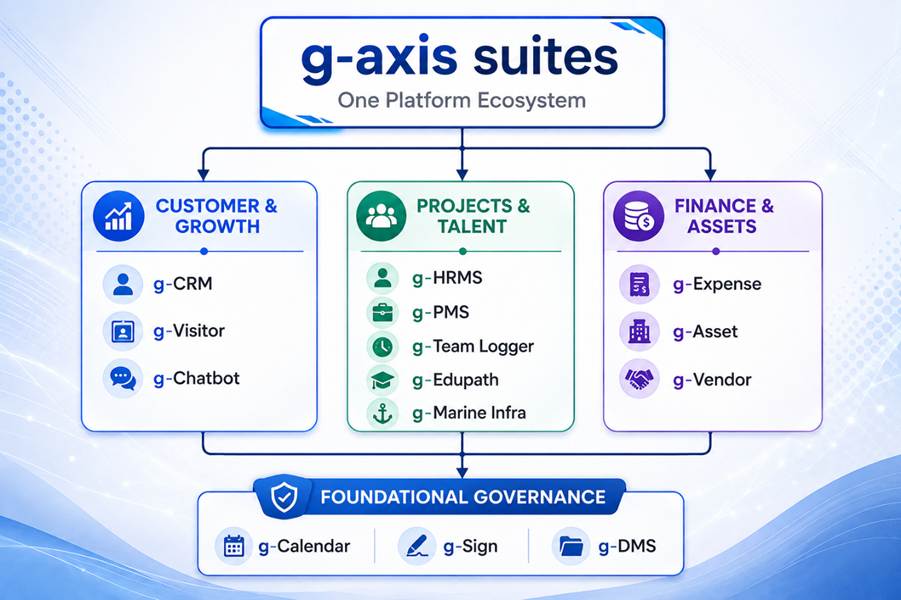
g-axis suites re-architects enterprise computing by replacing fractured multi-vendor subscriptions with a cohesive, end-to-end operational platform.
Built on the foundation that every business process is interconnected, g-axis suites ensures that when an event happens in one corner of your enterprise, every relevant department is instantly updated without human intervention.
- 14 Enterprise Modules in One Unified Ecosystem: Covering every touchpoint from client discovery and human capital to procurement, document signing, and physical logistics.
- 1 Single Unified Login & Master Data Model: Users authenticate once. Roles define permissions across modules. No duplicate employee, customer, or vendor master files.
- 100% Role-Based, Audited, and Access-Controlled: Every creation, modification, approval, and document download leaves an indelible, compliance-grade audit trail.
3. The 14 Connected Products: A Complete Deep-Dive
g-axis suites integrates 14 purpose-built products into one shared core engine. Here is how each module is structured to handle enterprise workloads:
3.1 Growth & Customer Operations
1. g-CRM (Customer Relationship Management)
- Core Function: Complete lead capture, customer lifecycle tracking, and sales pipeline optimization.
- How It Transforms Operations: Rather than trapping lead data inside isolated sales software, g-CRM integrates seamlessly with project planning and human resources. As soon as a lead moves from Proposal to Closed-Won, g-CRM can automatically trigger project onboarding in g-PMS, assign a delivery manager, and notify billing teams in g-Expense.
- Key Capabilities:
- Multi-channel lead ingestion from website forms, landing pages, and email inquiries.
- Customizable, multi-stage visual sales pipelines (Kanban boards).
- 360-degree interaction history (email threads, meeting logs, notes, and customer touchpoints).
- Real-time sales conversion and revenue forecasting dashboards.
2. g-Visitor (Digital & Physical Visitor Tracking)
- Core Function: End-to-end management of digital and on-premise physical visitors for enterprise facilities, corporate parks, and project sites.
- How It Transforms Operations: Say goodbye to insecure paper logbooks at front desks. g-Visitor delivers contact-free check-ins, automated host notifications via SMS/email, digital badge generation, and instant compliance logging.
- Key Capabilities:
- Self-service QR-code visitor pre-registration and check-in kiosks.
- Automated host alert system upon visitor arrival.
- NDA and security disclaimer signing before site entry (integrated with g-Sign and g-DMS).
- Comprehensive entry/exit timestamp logging for physical audit readiness.
3. g-Chatbot (AI-Assisted Support & Enterprise Self-Service)
- Core Function: 24/7 intelligent conversational automation for both external customer support and internal employee self-service.
- How It Transforms Operations: Deflects up to 70% of routine HR and customer queries. Employees can ask the chatbot about remaining leave balances, expense reimbursement statuses, or company policies without opening a support ticket.
- Key Capabilities:
- Context-aware natural language processing (NLP).
- Automatic retrieval from g-DMS knowledge bases and organizational policy documents.
- Frictionless escalation to human managers when complex issues arise.
- Omnichannel deployment across internal enterprise portals and customer-facing websites.
3.2 Human Capital & Operational Execution
4. g-HRMS (Human Resource Management System)
- Core Function: Managing the full employee lifecycle—recruitment, applicant tracking, onboarding, payroll processing, compliance, and structured separation.
- How It Transforms Operations: g-HRMS eliminates disconnected HR software. From candidate screening to digital offer letter issuance (via g-Sign) and automatic creation of asset allocation tickets (via g-Asset), HR workflows flow seamlessly without manual data entry.
- Key Capabilities:
- End-to-end recruitment funnel and resume parsing.
- Automated biometric and geo-fenced attendance tracking.
- Multi-tier statutory payroll processing with automated tax, PF, and deduction calculators.
- Employee self-service (ESS) portal for leave applications, tax declarations, and payslip downloads.
- Structured exit management, clearance workflows, and digital documentation.
5. g-PMS (Project Management System)
- Core Function: Comprehensive project planning, task decomposition, milestone tracking, resource allocation, and delivery monitoring.
- How It Transforms Operations: Bridges the critical divide between project execution and resource availability. Because g-PMS shares data with g-HRMS and g-Team Logger, project managers can see actual resource workloads and billable hours before committing to client delivery dates.
- Key Capabilities:
- Agile Scrum and Kanban boards with customizable sprint workflows.
- Interactive Gantt charts for dependency tracking and critical path analysis.
- Multi-tier task assignment, issue tracking, and priority management.
- Automated alerts for approaching deadlines and budget burn thresholds.
6. g-Team Logger (Productivity & Work Hour Tracking)
- Core Function: Precise tracking of employee working hours, active task times, and office productivity metrics.
- How It Transforms Operations: Enables data-backed management for remote, hybrid, and in-office teams. Provides real-time insights into which tasks consume team hours, making client billing transparent and resource re-allocation seamless.
- Key Capabilities:
- Background time tracking mapped directly against g-PMS tasks and client accounts.
- Activity metrics and idle time detection for productivity benchmarking.
- Automated timesheet generation and multi-level manager approval routing.
- Direct integration into payroll calculation engines within g-HRMS.
7. g-Edupath (Education, Training & Student Management)
- Core Function: Complete academic, student administration, and corporate learning management.
- How It Transforms Operations: Built to serve both educational institutions and enterprise corporate training divisions. Handles everything from curriculum scheduling and course enrollment to skills certification tracking.
- Key Capabilities:
- Course catalogue, syllabus scheduling, and student enrollment management.
- Digital attendance, assignment submissions, and grading matrices.
- Corporate skill matrix tracking to identify internal workforce upskilling opportunities.
- Automated digital course completion certificate generation via g-Sign.
3.3 Finance, Procurement & Supply Chain
8. g-Expense (Expense Submissions, Approvals & Reimbursement)
- Core Function: Centralized spend management, travel expense claims, multi-level approvals, and disbursement auditing.
- How It Transforms Operations: Eliminates lost receipts and manual expense spreadsheets. Employees upload receipts via mobile, the system extracts critical data, routes the claim through appropriate manager thresholds, and preps the payout for finance.
- Key Capabilities:
- Mobile receipt upload with automatic optical character extraction.
- Dynamic, multi-level approval hierarchies based on expense amount, department, or project code.
- Automated policy compliance checks (per diem caps, travel class limits).
- Direct export-ready reconciliation for finance and accounting ledgers.
9. g-Asset (Hardware, Software & Asset Lifecycle Management)
- Core Function: Complete hardware, software license, and equipment allocation, tracking, depreciation, and maintenance.
- How It Transforms Operations: Gives IT and admin teams total visibility into every physical and digital asset. When an employee is onboarded in g-HRMS, laptop and peripheral allocation is recorded in g-Asset. During offboarding, the clearance ticket guarantees no asset is left unrecovered.
- Key Capabilities:
- Unique QR-code and barcode asset tagging and physical audit scanning.
- Asset allocation history tracking mapped to specific employees and branch offices.
- Scheduled preventative maintenance, warranty tracking, and service contract alerts.
- Automated straight-line and written-down value (WDV) depreciation schedules.
10. g-Vendor (Procurement, Purchase Orders & Supplier Sourcing)
- Core Function: Vendor onboarding, Request for Quotation (RFQ) workflows, Purchase Order (PO) creation, and supplier performance evaluation.
- How It Transforms Operations: Closes the backdoor spending loop. Procurement requests must be mapped to verified vendors, checked against departmental budgets, and approved before POs are officially generated and transmitted.
- Key Capabilities:
- Centralized vendor repository with tax verification, bank details, and compliance certifications.
- Standardized Purchase Requisition (PR) to Purchase Order (PO) conversion pipelines.
- 3-way matching between PO, delivery receipt (GRN), and vendor invoice.
- Historical supplier performance analytics based on delivery punctuality and quality.
11. g-Marine Infra (Supply Chain & Specialized Marine Operations)
- Core Function: Enterprise supply chain management with dedicated functional capabilities for marine infrastructure, shipping logistics, and heavy material transit.
- How It Transforms Operations: Heavy engineering, port management, and specialized infrastructure projects require unique logistics tracking that generic supply chain tools cannot handle. g-Marine Infra bridges physical cargo movement with enterprise resource planning.
- Key Capabilities:
- Cargo movement, consignment tracking, and freight manifest visibility.
- Vessel schedule coordination, berthing allocations, and dockside resource management.
- Multi-modal supply chain milestone monitoring from supplier facility to site.
- Integrated regulatory and customs documentation compliance.
3.4 Foundational Governance, Documents & Scheduling
12. g-DMS (Document Management System)
- Core Function: Centralized cloud document generation, metadata tagging, secure folder hierarchies, and enterprise storage.
- How It Transforms Operations: Replaces disconnected Google Drive folders and desktop file hoarding with an audited, enterprise-wide repository. Search contracts, policy revisions, tax forms, and employee records in seconds.
- Key Capabilities:
- Instant full-text search with metadata and document attribute tagging.
- Granular folder and document-level view, edit, download, and share permissions.
- Complete version control history with instant rollback capabilities.
- Built-in dynamic document generation (letters, invoices, and certificates).
13. g-Sign (Secure Digital Document Signing)
- Core Function: Legally compliant, tamper-evident digital signatures embedded directly into enterprise document flows.
- How It Transforms Operations: Eliminates the printing, scanning, and courier cycle. HR offer letters, vendor service contracts, non-disclosure agreements, and client change orders are routed for verified digital signing directly within the ecosystem.
- Key Capabilities:
- Bank-grade cryptographic digital signature hashing.
- Multi-party signature routing with strict sequential signing order.
- Tamper-evident digital audit trail recording IP address, email verification, and timestamps.
- Seamless auto-storage of executed documents directly into g-DMS.
14. g-Calendar (Enterprise Scheduling & Event Coordination)
- Core Function: Enterprise-wide calendar management, cross-departmental meeting scheduling, resource/room booking, and critical milestone tracking.
- How It Transforms Operations: Ensures that scheduling is not locked into personal email calendars. Facilitates cross-departmental project syncs, interview scheduling linked to g-HRMS, and client calls linked to g-CRM deals.
- Key Capabilities:
- Seamless multi-calendar overlay for instant team availability checks.
- Meeting room, project asset, and resource reservation management.
- Direct synchronization with g-PMS project milestone deadlines.
- Automated calendar invites with location links and push notification alerts.
4. Cross-Module Architectural Synergy: Real Scenarios
The true value of g-axis suites is realized when modules communicate autonomously. Here are two everyday business scenarios comparing traditional multi-vendor stacks against the g-axis suites unified model:
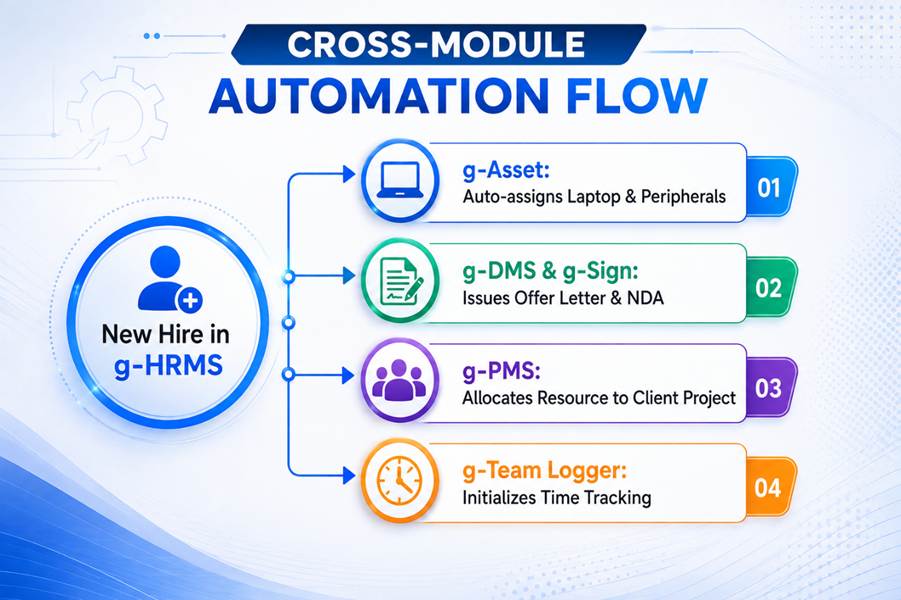
Scenario A: The New Employee Onboarding Journey
- The Fragmented Stack Way:
- HR emails the signed offer letter PDF.
- HR manually inputs candidate data into the payroll software.
- HR emails the IT helpdesk requesting a laptop setup.
- IT tracks the laptop in an internal spreadsheet.
- The project manager manually adds the user to the project board.
- The employee asks where to submit time records and files expenses on paper.
- Total Time: 3 to 5 business days. Significant risk of missed steps.
- The g-axis suites Way:
- Candidate accepts offer via g-Sign; document automatically archives in g-DMS.
- g-HRMS creates the active employee record and unified login profile.
- g-Asset generates a provisioning ticket for IT with pre-approved hardware kits.
- g-PMS assigns the employee to their initial project sprint with default role permissions.
- g-Team Logger and g-Expense accounts are immediately activated under the same login.
- Total Time: Under 5 minutes. 100% automated and fully audited.
Scenario B: Client Project Milestone Billing & Spend
- The Fragmented Stack Way:
- Project managers track completion in standalone tools.
- Timesheets are manually compiled from desktop software.
- Expense receipts are forwarded in email threads.
- Finance spends days cross-referencing timesheets against client contracts to draft an invoice.
- Total Time: 7 to 10 days post-milestone.
- The g-axis suites Way:
- Milestone completion is validated inside g-PMS.
- Billable hours from g-Team Logger and approved project expenses from g-Expense are automatically rolled up.
- The billing invoice is generated via g-DMS, tied back to the account in g-CRM, and sent to the client via g-Sign.
- Total Time: Same-day execution with zero billing discrepancies.
5. Architectural Comparison: Legacy/Point Solutions vs. g-axis suites
| Strategic Metric | Point Solutions / Fragmented Stack | g-axis suites (Gitakshmi Ecosystem) |
| Authentication & Access | Multiple logins, mismatched passwords, manual SSO setups. | One Unified Login with centralized, role-based access control (RBAC). |
| Data Integrity | Fragmented data silos, duplicate entries, manual CSV syncs. | One Shared Master Data Model across all 14 business products. |
| Total Cost of Ownership (TCO) | 5-10 separate vendor invoices, recurring connector fees, high IT support overhead. | Single SaaS subscription model; pay only for modules your business actually uses. |
| Audit & Compliance | Disparate logs across platforms; difficult manual compliance audits. | 100% End-to-end system audit trail; unified activity and security logging. |
| Workflow Automation | Requires complex third-party tools (Zapier, custom webhooks, brittle scripts). | Native cross-module automation built into the core platform layer. |
| Onboarding & Adoption | Employees must learn 6 different user interfaces and designs. | Consistent UI/UX across all business tools, reducing training curves. |
6. The Technology Engine & Enterprise Trust Behind Gitakshmi
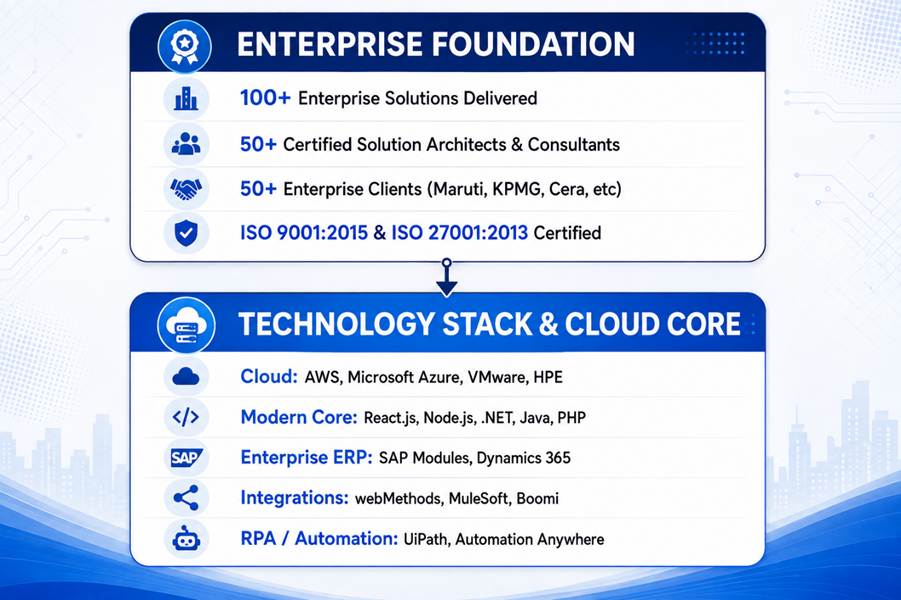
A business operating system is only as dependable as the engineering architecture and organizational pedigree behind it. g-axis suites is designed, deployed, and supported by Gitakshmi Technologies—an established enterprise automation and systems integration partner.
6.1 Backed by Proven Industry Experience
- 100+ Enterprise solutions architected and deployed globally.
- 50+ SAP integration modules and enterprise workflows delivered.
- 9+ Active industry verticals (Manufacturing, FMCG, Mining, Technology, Reality, and Consulting).
- 6+ Regional operational presences.
- 50+ Certified enterprise professionals and architects.
6.2 Industry Recognitions & Compliance Standards
- ISO 9001:2015 Certified: Adherence to strict international quality management standards.
- ISO 27001:2013 Certified: Information security management and data protection.
- Microsoft Partner & AWS Partner Network: Validated cloud architecture and implementation excellence.
- Clutch Top Developer (India): Recognized for bespoke development and client delivery satisfaction.
6.3 Validated Across Industry Giants
Gitakshmi’s enterprise solutions and digital platforms are trusted across leading corporations, including:
- Automotive & Heavy Industry: Maruti Suzuki, Ratnamani Metals & Tubes Ltd., Sadbhav, Balasore Alloys Limited, BKT.
- Consumer Goods & FMCG: Parle, Charliee, Cera.
- Consulting & Professional Services: KPMG, Delaware, Uneecops Business Solutions.
- Energy, Gas & Infrastructure: Aavantika Gas Limited (A joint venture of GAIL & HPCL), ITD Cem, Servotec, Highbar Technocrat.
- Mining & Metals: Ashapura Group of Industries, Gravita, Nouvelle Gabon Mining.
7. The 5-Stage Implementation Delivery Model
The biggest barrier to enterprise software adoption is implementation risk: scope creep, prolonged timelines, broken business processes, and user resistance.
To de-risk your software rollout, Gitakshmi follows a structured, sprint-based delivery methodology with fixed track capacity and variable specialized skills:
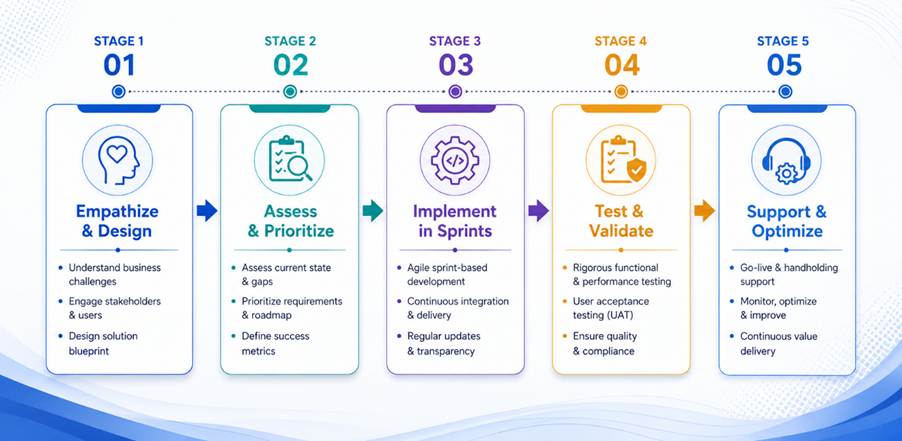
Stage 1: Empathize & Design
Transformation starts with listening. Solution architects conduct design-thinking discovery workshops with your operational stakeholders to map real daily workflows, identify functional bottlenecks, and document exact pain points.
Stage 2: Assess & Prioritize
Rather than attempting an overwhelming “big-bang” deployment, requirements are structured into a prioritized delivery backlog. High-impact operational priorities are identified for quick wins.
Stage 3: Implement in Sprints
A dedicated core team of certified solution architects and engineers executes configuration and customization in focused, time-bound sprints. This guarantees continuous visibility and client feedback loops throughout the build.
Stage 4: Test & Validate
Rigorous Quality Assurance (QA) is executed alongside hands-on User Acceptance Testing (UAT). Real business scenarios are simulated to confirm data integrity, workflow correctness, and access-control security before go-live.
Stage 5: Support & Optimize
Post-deployment, Gitakshmi provides ongoing application management, user adoption training, performance tuning, and continuous enhancements aligned with your scaling business goals.
8. What Operational Success Looks Like
Deploying g-axis suites delivers quantifiable improvements across your organization:
- Platform Live & Accessible: Fast deployment with users authenticated under one consolidated ecosystem.
- Centralized Operations from Day One: Departmental silos collapse into a shared operating dashboard.
- Measurable Efficiency Gains: 60-80% reduction in manual data entry, paper trails, and unmonitored approval loops.
- Enterprise Security & Compliance: Complete, audited visibility over company assets, contracts, and internal access rights.
- Immediate ROI & Capital Optimization: Elimination of redundant software subscriptions and associated integration maintenance costs.
9. Frequently Asked Questions (FAQs)
Q1: Can our company start with just a few modules (e.g., HRMS and PMS) and add others later?
Yes. g-axis suites is built on a modular subscription model. You can begin by deploying the specific products your organization needs today (such as g-HRMS and g-PMS) and seamlessly activate additional modules (like g-Asset, g-Expense, or g-CRM) as your operational scope scales—without needing to migrate data or configure new logins.
Q2: How does g-axis suites integrate with existing enterprise ERPs like SAP?
Gitakshmi Technologies has delivered over 50 SAP enterprise modules and integrations. g-axis suites can operate as your day-to-day engagement and operational layer while synchronizing financial ledgers, inventory counts, or procurement orders bi-directionally with core ERPs (SAP, Microsoft Dynamics) via enterprise middleware (webMethods, MuleSoft, Boomi).
Q3: How is our corporate data protected inside the platform?
Security is embedded at the architectural level. g-axis suites utilizes role-based access control (RBAC), end-to-end data encryption (in-transit and at-rest), ISO 27001:2013-certified security practices, and granular activity logging that tracks every document view, edit, and download.
Q4: How does g-axis suites compare to buying standalone tools like HubSpot, Jira, and BambooHR?
While standalone platforms are feature-rich in isolation, maintaining separate tools results in fragmented data, high subscription costs, multiple user accounts, and continuous integration upkeep. g-axis suites provides a unified, cross-connected operational system where sales, projects, HR, assets, and finance natively share data at a fraction of the total cost of ownership.
10. Conclusion: Ready to Unify Your Business Operations?
Software fragmentation is an operational roadblock that slows growth, frustrates teams, and obscures executive visibility.
With g-axis suites, you no longer need to compromise between deep departmental functionality and unified enterprise control. From lead discovery to asset allocation, project milestones, and employee payroll, experience the power of One Platform • Infinite Possibilities.