Every growing enterprise eventually runs headfirst into a silent capital crisis: operational fragmentation. You purchase 300 developer-grade workstations, 50 network switches, industrial measurement tools for floor testing, power backups, and specialized production machinery across three manufacturing facilities and four regional corporate branches. For twelve months, business runs smoothly. Then an auditor asks for the physical location, depreciation schedule, and current custodian of physical device #IT-BLR-0842.
The response is usually a slow scramble: five disconnected WhatsApp groups, three versions of a shared Excel spreadsheet last touched seven months ago, and an IT support desk that insists the machine was reassigned to an employee who resigned last quarter.
In modern enterprise operations, missing equipment is not merely an administrative headache. It is an uncontained drain on working capital, an invisible cyber risk, and a direct threat to regulatory compliance. Hardware is purchased twice because teams cannot locate what is already in storage. Software licenses renew automatically for employees who left months ago. Critical plant machinery breaks down because preventive maintenance was tracked on a whiteboard that got wiped clean. And when statutory auditors arrive, finance and operations teams waste weeks reconciling paper invoices with ghost inventory.
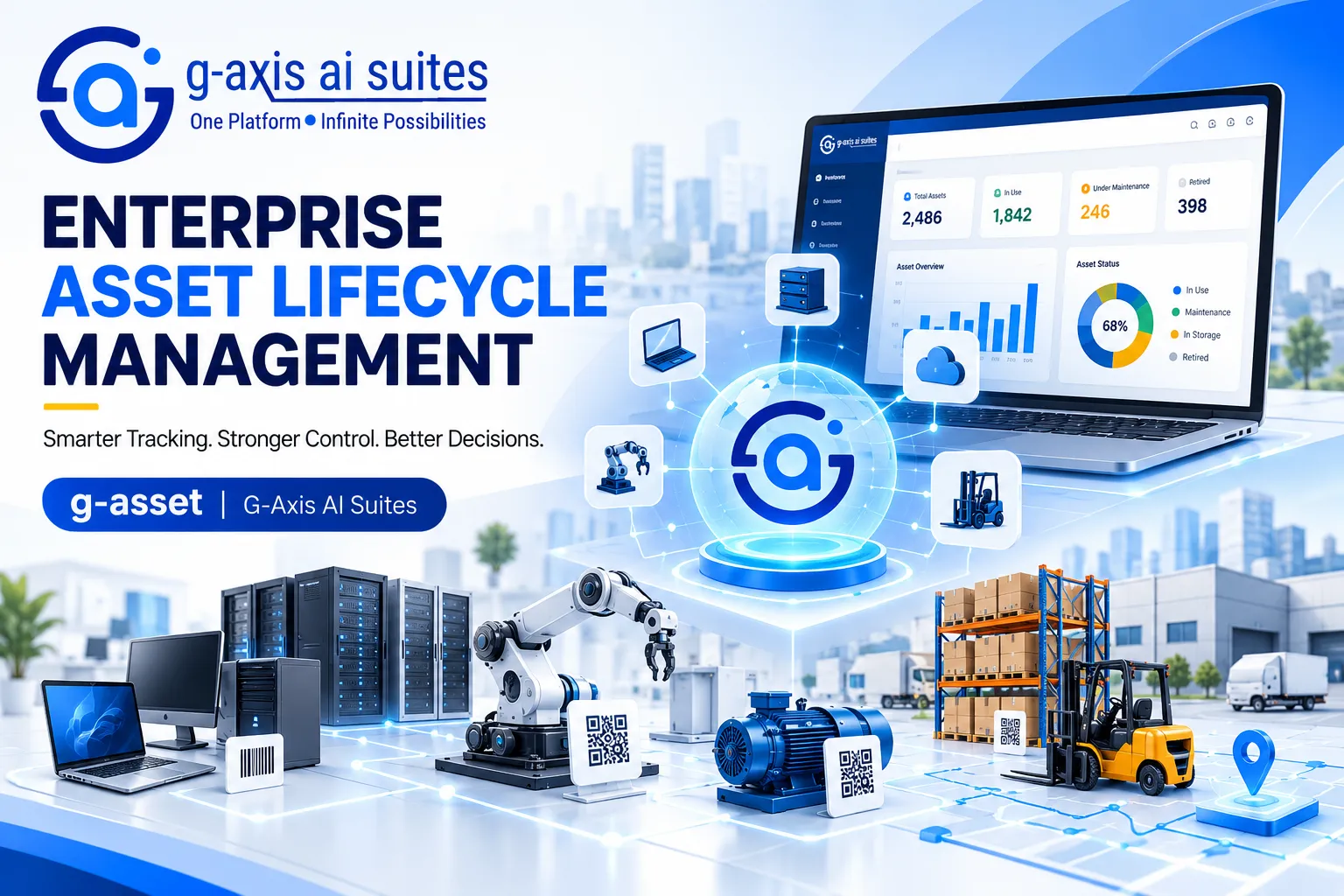
This definitive technical blueprint breaks down the exact mechanics of modern asset lifecycle governance, structural cost control, depreciation engineering, and proactive machine health. It details how an intelligent system like g-asset, operating as a core operational engine within the g-axis AI suite, bridges the historical divide between operational shop-floor tracking and enterprise financial ledger accuracy.
1. The Core Paradigm: Moving Beyond Passive Registers to Dynamic Asset Intelligence
Traditional enterprise resource management treats asset tracking as an accounting afterthought. An asset is entered into an enterprise ledger when an invoice is cleared, assigned a generic depreciation period, and forgotten until physical audit season.
This passive, retrospective model fails in environments characterized by distributed hybrid workforces, multi-cloud microservices, complex supply chains, and high-cadence manufacturing floors.
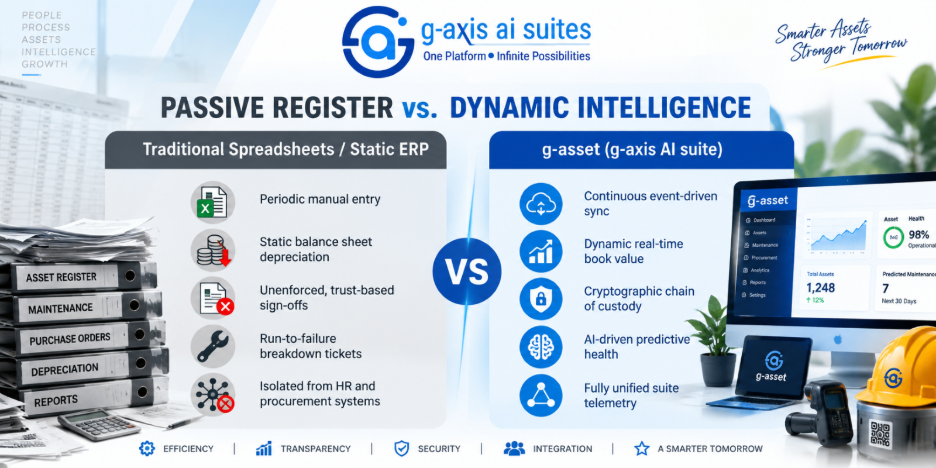
An Asset Management System (AMS) is an operational control plane. It binds the physical identity, digital footprint, operational telemetry, financial valuation, and regulatory chain of custody of every capital item into a single, real-time feedback loop.
When implemented with intelligent architectural logic, the asset system answers four critical enterprise questions instantly:
- Verifiable Custody: Which exact human, process, or physical rack owns operational responsibility for this item right now?
- Contextual Health: What is the asset’s degradation curve, operating temperature, network patch status, or calibration drift relative to its baseline?
- True Total Cost of Ownership (TCO): When factoring acquisition, consumable wear, routine servicing, emergency downtime, and power consumption, is this asset returning positive ROI, or is it draining capital?
- Lifecycle Trajectory: At what exact juncture does the cost of maintaining this equipment surpass the amortized replacement cost of a modernized alternative?
2. Structural Breakdown: The Four Enterprise Asset Quadrants
To prevent operational chaos, an enterprise asset system must apply specialized data schemas, tracking mechanisms, and compliance protocols across four distinct asset classes. A single generic form cannot track a diesel generator and a Kubernetes cloud subscription identically.
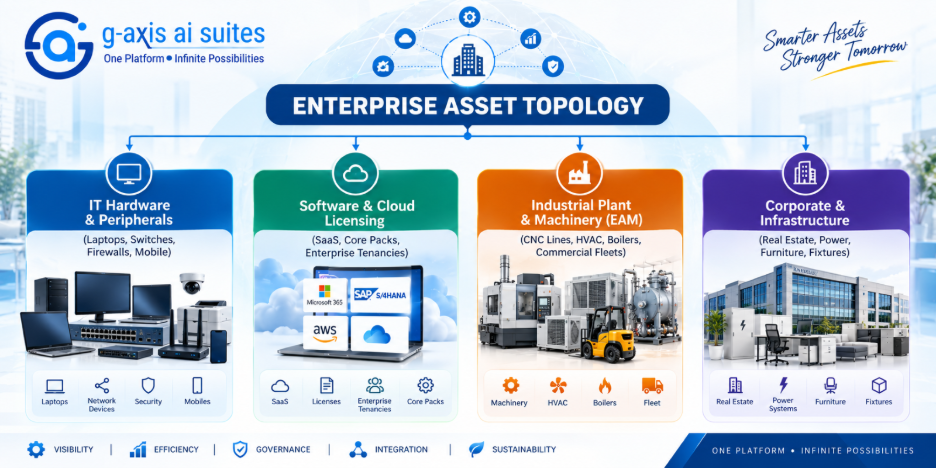
Quadrant I: Information Technology Hardware (ITAM)
IT hardware represents high-velocity, high-risk items. Laptops, portable testing devices, managed routers, managed firewalls, and server blades change physical custody frequently.
- Critical Tracking Vectors: Serial numbers, MAC addresses, IMEI, processor tier, disk encryption status, secure boot validation, warranty endpoints, and operating system build versions.
- Risk Vectors: Data leakage via lost or stolen endpoint storage, ghost hardware sitting in employee homes post-resignation, and out-of-compliance network interfaces introducing vulnerabilities into the corporate perimeter.
Quadrant II: Software Assets, SaaS & Cloud Tenancies (SAM)
Intangible assets often represent the fastest-growing operational expenditure within modern companies. Without rigorous tracking, organizations suffer from “seat creep,” paying for abandoned corporate licenses and unassigned cloud computing instances.
- Critical Tracking Vectors: License key allocations, seat utilization rates, monthly recurring billing schedules, enterprise agreements (EA) true-up dates, vendor audit rights, and cloud instance tags.
- Risk Vectors: Substantial financial penalties during vendor compliance audits (e.g., database or ERP seat audits) and ungoverned “Shadow IT” sign-ups bypassing security reviews.
Quadrant III: Enterprise Plant, Equipment & Heavy Machinery (EAM/CMMS)
This encompasses the physical muscle of the enterprise: CNC machinery, fabrication tools, factory automated conveyors, commercial vehicle fleets, hydraulic presses, air handling units, and power substations.
- Critical Tracking Vectors: Operating hours, runtime vibration profiles, power draw, oil change intervals, statutory inspection certifications, mean time between failures (MTBF), and mean time to repair (MTTR).
- Risk Vectors: Unplanned assembly line downtime, catastrophic mechanical failure, workplace safety compliance breaches, and premature machine wear due to neglected preventive maintenance.
Quadrant IV: Capital Infrastructure & Fixed Facilities
Fixed assets anchor the organization’s long-term balance sheet: real estate holdings, commercial office fit-outs, heavy industrial racking, modular partitions, central HVAC systems, and corporate furnishings.
- Critical Tracking Vectors: Physical floor plan coordinates, structural warranty records, commercial lease schedules, local municipality safety certifications, and specialized asset capitalization codes.
- Risk Vectors: Overpaying municipal property taxes on dismantled structures and inaccurate insurance coverage calculations based on un-audited replacement values.
3. The 6-Stage Autonomous Lifecycle: Technical Architecture
Every enterprise asset follows a chronological trajectory from capitalization to decommission. g-asset enforces operational gates at every transition, preventing items from advancing through the pipeline without verified data collection.
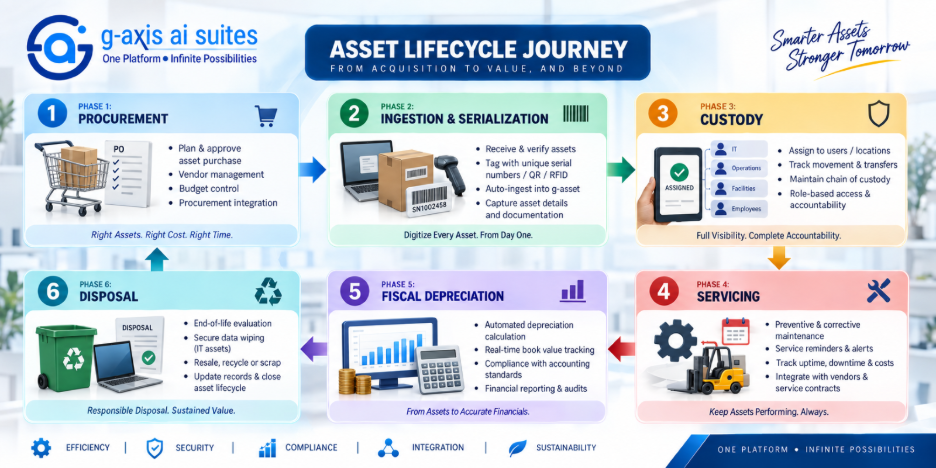
Phase 1: Strategic Sourcing & Digital Ingestion
The lifecycle does not begin when an asset is unboxed; it begins when purchase authorization is granted. Within an integrated ecosystem like the g-axis AI suite, when a purchase requisition is approved within g-procurenet, an unverified asset placeholder is automatically generated inside g-asset.
- The digital record captures the purchase order number, supplier tax invoice, GST/VAT documentation, contractual warranty parameters, and original unit acquisition cost.
- By pre-populating records before physical delivery, receiving bays never encounter “unidentified freight” waiting for manual paperwork processing.
Phase 2: Physical Serialization, Cryptographic Tagging & Onboarding
Upon dock delivery or office reception, the asset undergoes physical ingestion. The receiving engineer verifies the item against the digital packing list and applies a tamper-evident identification marker.
- Asset Tagging Protocols:
- Dynamic QR Codes: Used for general IT gear and corporate assets. Scannable via any camera-enabled smartphone running the secure mobile interface; links instantly to the asset’s active cloud telemetry profile.
- Passive Gen-2 RFID Tags: Deployed for high-density warehouse environments, tools, and shared equipment pools. Enables non-line-of-sight mass scanning of hundreds of items in seconds during physical audits.
- Active BLE / Industrial IoT Beacons: Reserved for high-value mobile machinery, hospital equipment, or specialized tooling across large manufacturing campuses to deliver continuous indoor location coordinates.
- Master Record Seeding: At this gate, initial configuration baselines are permanently locked: hardware serial, MAC address, physical specifications, and designated home department.
Phase 3: Deployment, Dynamic Custody & Multi-Factor Sign-off
An asset must never change hands without an indisputable audit trail. Handing a field engineer a diagnostic unit or assigning a remote developer a workstation requires active mutual acknowledgment.
- Two-Way Authentication: The assigner scans the physical asset tag; the recipient approves custody via their unified employee portal or corporate authentication application.
- Contextual Tagging: The asset record maps to the employee’s internal identity profile, cost center, reporting manager, and physical desk or project location.
- Conditional Custody Rules: The system automatically rejects assignment if the user already holds unreturned items exceeding company policy or lacks required safety/equipment operation certifications.
Phase 4: Operational Runtime, Telemetry & Preventive Maintenance
During the active life of an asset, the system actively tracks its operational efficiency and physical condition.
- Preventive Maintenance Schedules (PMS): Maintenance is shifted from reactive emergency repair to calendar- or usage-based triggers (e.g., “Service pump after every 500 hours of runtime” or “Calibrate torque wrenches every 90 days”).
- Service Tickets & Work Orders: Machine operators can instantly scan the machine’s physical QR code to review historic maintenance tickets, log emerging issues, attach photographic evidence of wear, and dispatch tickets directly to internal maintenance engineers.
Phase 5: Fiscal Depreciation & Dynamic Asset Ledger Balancing
An asset management platform must be technically aligned with accounting standards (such as Ind AS 16, US GAAP, and IFRS). Every second of asset utilization must be accurately reflected on the corporate balance sheet.
- Automated Depreciation Calculations: The system maintains dual schedules: statutory tax depreciation books (e.g., accelerated rates under local tax codes) and financial reporting books (e.g., straight-line methods based on true useful operating life).
- Mid-Life Capitalization: If an industrial asset receives a major overhaul that extends its operating life (e.g., replacing a major motor assembly), g-asset capitalizes the enhancement cost into the asset’s residual base, recalculating forward-looking amortization tables automatically.
Phase 6: Decommissioning, Chain-of-Custody Wiping & Safe Disposal
The end of an asset’s lifecycle carries severe regulatory, environmental, and cybersecurity exposure if handled incorrectly.
- Cryptographic Data Erasure (NIST SP 800-88 Standards): Before any computing asset is decommissioned, automated scripts verify that disks have been wiped and unlinked from enterprise Active Directory systems, generating an auditable Certificate of Sanitization.
- E-Waste & Hazardous Asset Compliance: Disposal must align with statutory electronic waste regulations. The system records the registered recycler’s license details, hazardous disposal certificates, and final scrap sale recovery invoice, permanently closing out the asset ledger.
4. The Intelligence Layer: How the g-axis AI Suite Powers g-asset
Traditional software platforms are passive databases: they hold information, but human operators must notice trends, spot leaks, and initiate action. Because g-asset is built natively on the intelligent foundations of the g-axis AI suite, it converts static asset tracking into an autonomous operational nerve center.
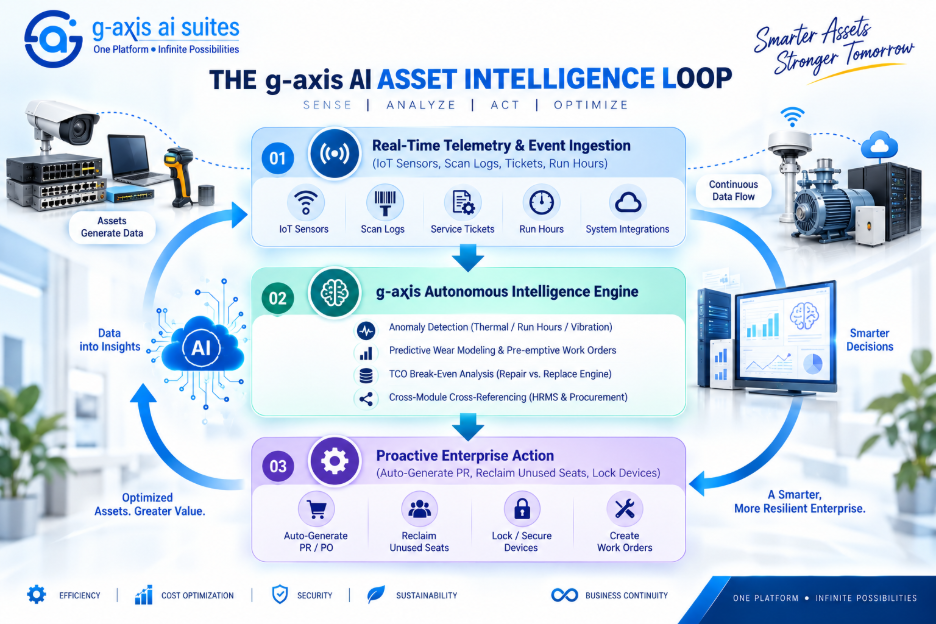
Autonomous Predictive Maintenance (PdM)
Instead of relying strictly on static manufacturer maintenance guidelines—which frequently lead to either unnecessary part replacements or unexpected breakdowns—the platform cross-analyzes real-world conditions:
- Machine run-time telemetry, thermal logs, vibration sensors, and environmental humidity are processed continuously.
- The system detects minute harmonic anomalies and performance degradation days before human operators notice a noise or vibration, automatically creating prioritized work orders and reserving spare parts from inventory.
The Repair-vs-Replace Economic Modeling Engine
Plant and fleet managers frequently struggle with the classic dilemma: Should we invest in another repair for an aging machine, or is it time to scrap and purchase new equipment?
- The system evaluates cumulative historic repair spend, technician labor, lost production revenue during downtime, spare part inflation, and degrading energy efficiency against current market replacement pricing.
- When the algorithmic inflection point is crossed, the system issues an executive advisory with definitive financial justification: “Operating Asset #CNC-04 carries a projected 14-month TCO that is 22% higher than capital amortization of a new generation unit.”
Cross-Ecosystem Synchronization with g-axis HRMS & g-procurenet
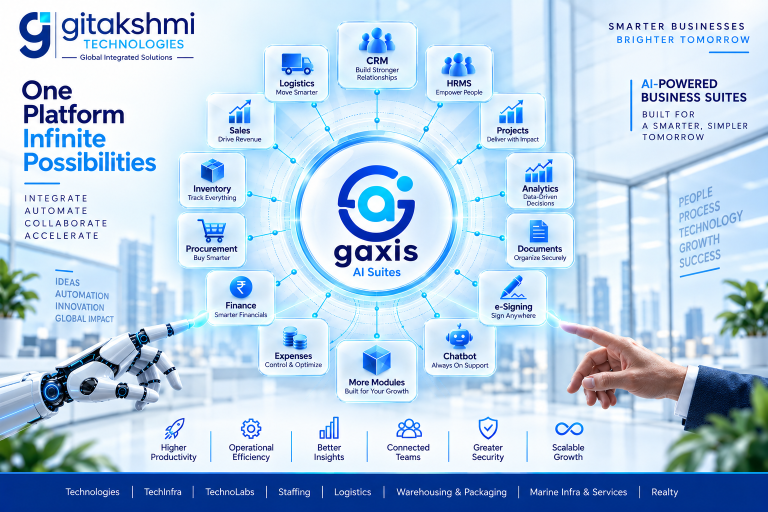
The true strategic power of g-asset emerges from its deep native integration across the broader g-axis AI suite:
- Automated HR Offboarding Reclamation: When an employee separation is initiated inside g-axis HRMS, a parallel task immediately activates inside g-asset. The system compiles every hardware token, laptop, monitor, company vehicle, and software seat assigned to that employee. Final payroll and HR sign-offs cannot proceed until all physical QR scans confirm the assets have been safely returned to IT inventory.
- Zero-Touch Onboarding Provisioning: As soon as an offer letter is accepted in the HRMS, the system evaluates available buffer stock, reserves a configured device, tags it for the employee’s reporting branch, and orders missing accessories through integrated procurement channels.
- Vendor Risk & Warranty Synchronicity: When machinery requires specialized repairs, the platform cross-references contractor SLAs and insurance covenants recorded within g-procurenet, ensuring warranty claims are applied automatically rather than paid out of pocket due to lack of visibility.
5. Architectural Comparison: Legacy Tools vs. Modern AI Asset Systems
To understand why traditional systems fail to scale within growing organizations, review how operational tasks diverge between disconnected setups and modern, unified platforms:
| Architectural Vector | Legacy Manual Methods (Spreadsheets / Paper) | Traditional Mid-Market Software (Isolated Tools) | Modern Native AI Engine (g-asset / g-axis AI suite) |
| Data Ingestion | Manual copy-pasting from vendor PDFs; vulnerable to typos and skipped items. | Manual record creation per device; basic CSV uploads without structural verification. | Automated parsing from digital POs; instant mobile QR/RFID enrollment in under 5 seconds. |
| Audit Speed & Accuracy | 3 to 6 weeks of physical searches; 15–30% variance and unverified “presumed lost” assets. | Days of manual barcode scanning; errors require slow, manual reconciliation. | Continuous passive verification via RFID sweeps and zero-trust endpoint network check-ins. |
| Maintenance Model | Purely reactive; equipment runs until failure, halting operations. | Calendar-based static reminders; often ignored or missed during peak operational cycles. | Dynamic, condition-based predictive maintenance powered by runtime telemetry and sensor feeds. |
| Offboarding Recovery | High asset loss; remote assets routinely forgotten when employees resign. | Manual notification email sent to IT desk; relies on human tracking and follow-up. | Autonomous hard-lock on HR exit initiation; full reclamation workflow required for final clearance. |
| Software License Control | Unmonitored; licenses renew automatically whether utilized or abandoned. | Periodic manual reconciliation against vendor invoices once or twice a year. | Continuous real-time usage tracking; automated seat revocation and reclamation for idle licenses. |
| Depreciation Modeling | Disconnected yearly spreadsheet adjustments; frequently out of sync with physical assets. | Basic straight-line depreciation calculated separately from day-to-day operations. | Real-time dual-book calculation (Tax vs. Book) with automated adjustments for mid-life improvements. |
6. Financial and Tax Governance: Eradicating Ghost Assets and Protecting Margins
Unmanaged asset registers corrupt corporate financial reporting at a foundational level. Two distinct phenomena degrade profitability when assets are tracked loosely:
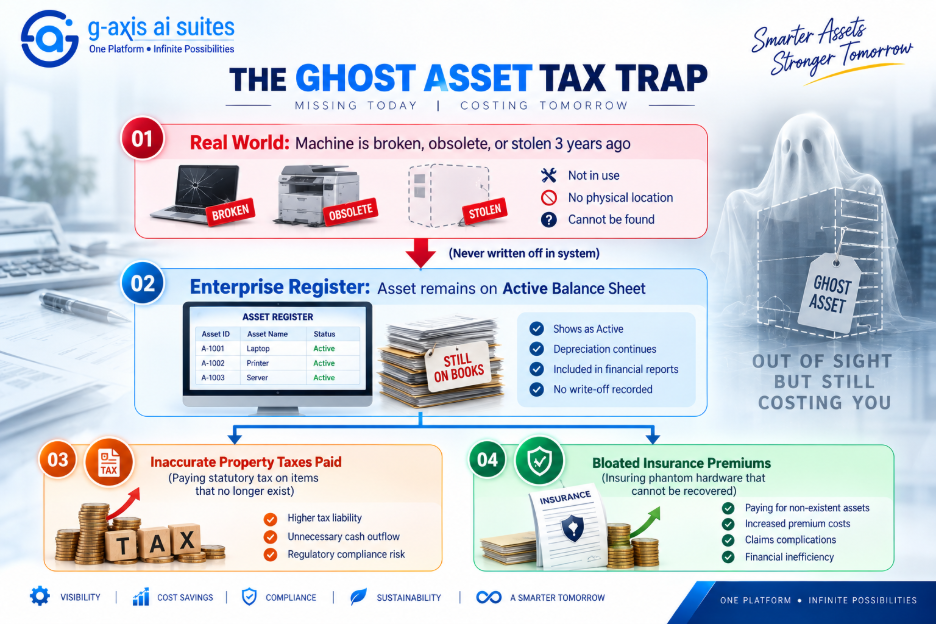
The Elimination of Ghost Assets
A “Ghost Asset” is an item that exists on the general ledger but cannot be physically located in the enterprise. According to industry studies, anywhere from 10% to 25% of fixed assets listed on un-audited corporate registers are phantom items:
- The Compounded Loss: Companies continue to pay active insurance premiums on ghost equipment. In jurisdictions with local equipment and personal property taxes, corporations pay ongoing operational taxes on hardware that was scrapped years ago.
- The g-asset Fix: The system institutes an unbending policy of continuous automated reconciliation. If an asset is not physically scanned, detected on the local network, or pinged by an agent for a predefined threshold (e.g., 60 days), it is moved to an “Audit Exception” status. If unverified after escalation, it routes directly to finance for an immediate, formal loss write-off, instantly eliminating unnecessary insurance premiums and property tax liabilities.
Managing “Zombie Assets”
Conversely, “Zombie Assets” are physical machines operating inside the plant or office that do not exist anywhere on the company’s books. They are purchased under broad expense categories (OPEX) instead of capital budgets (CAPEX), or assembled from scavenged components.
- The Exposure: Zombie assets operate without maintenance coverage, carry unknown cyber risks when plugged into corporate networks, and represent uninsurable liabilities during industrial accidents.
- Serialization Control: Through strict dockside tagging gates and active network scanning integrations, g-asset discovers uncataloged hardware the moment it requests an internal IP address or crosses a warehouse checkpoint, alerting administrators to assign formal ownership immediately.
7. Blueprint: Enterprise-Grade Implementation Methodology
Deploying an enterprise asset management platform across multi-location operations requires structured execution. Rushing software adoption without establishing baseline physical discipline guarantees poor data quality.
Follow this field-tested, four-phase rollout roadmap:
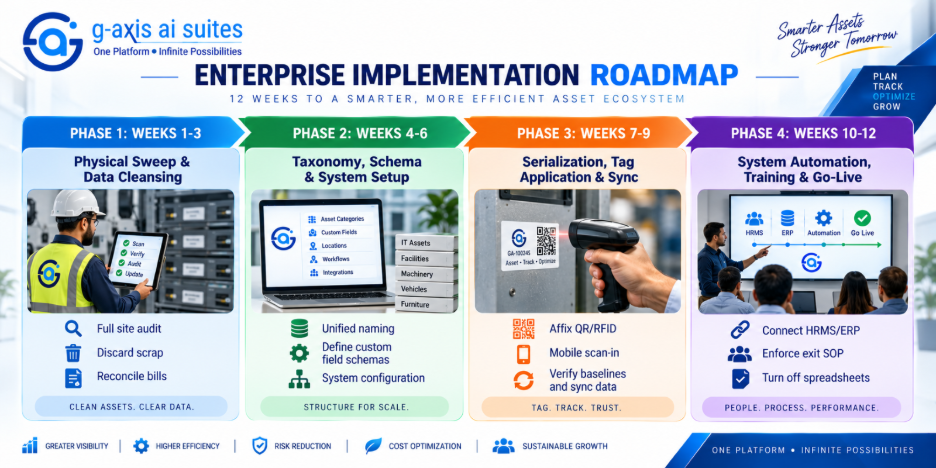
Phase 1: The Baseline Physical Sweep and Record Cleansing (Weeks 1–3)
Do not import an inaccurate legacy spreadsheet into a modern system. You will simply automate historical errors.
- Physical Mobilization: Dispatch unified inventory teams to catalog every operational room, server rack, production bay, and satellite site.
- Scrap Liquidation: Identify all non-functional, obsolete machinery sitting in storage. Do not tag them into the new system. Formally decommission, auction, or dispose of them under e-waste governance immediately.
- Invoice Reconciliation: Match surviving items with vendor purchase orders, serial numbers, and existing depreciation entries. Build a validated, clean CSV foundation.
Phase 2: Taxonomy Architecture and Category Configuration (Weeks 4–6)
A system is only as usable as its data taxonomy. Establish strict naming conventions and attribute schemas before issuing tags.
- Standardized Naming Conventions: Replace ambiguous names like “Dell Laptop” with strict taxonomic strings: [Category] – [Manufacturer] – [Model Tier] – [Unique ID] (e.g., IT-DELL-LAT5440-00341).
- Attribute Mapping: Define mandatory data points per asset tier. IT hardware requires MAC addresses and disk encryption keys; production machines require operating voltage, maximum pressure limits, and vendor emergency service phone numbers.
- Role-Based Access Logic (RBAC): Configure organizational permissions. Branch managers should receive check-in/check-out rights for their regional facilities; plant maintenance heads manage work orders and preventive tickets; corporate finance holds global depreciation visibility.
Phase 3: Physical Serialization and Digital Ingestion (Weeks 7–9)
Transition verified records to physical items via durable, tamper-evident physical tags.
- Selecting Physical Label Media:
- Office IT Assets: Use poly-laminate, scratch-resistant dynamic QR labels with permanent acrylic adhesive.
- Industrial Machinery & Outdoor Fleet: Use anodized aluminum metallic barcode/QR plates affixed with high-durability epoxy or mechanical rivets designed to survive chemical exposure, steam cleaning, and extreme temperatures.
- Server Blades & Rack Infrastructures: Deploy compact on-metal passive RFID tags to allow rapid cabinet sweeps without disconnecting cables.
- Scan-and-Bind Execution: Using the g-asset mobile interface, teams scan the physical tag code, scan the manufacturer’s serial barcode, confirm physical location, and lock the record in the cloud database in a single 15-second operation.
Phase 4: Workflow Automation, Cross-System Integration and Go-Live (Weeks 10–12)
Activate ecosystem integrations and deprecate legacy manual processes permanently.
- Ecosystem Linking: Establish API connectivity between g-asset, g-axis HRMS for automated employee asset transfers, and g-procurenet for purchase ingestion.
- Policy Enforcement: Formalize standard operating procedures: No asset enters or leaves an enterprise facility without a mobile scan confirmation at the checkpoint.
- Spreadsheet Decommissioning: Revoke edit permissions on all historical asset spreadsheets. All operational movements must now flow through the central system.
8. Strategic Value: Quantifying the Return on Investment
Implementing an intelligent, automated asset platform delivers measurable financial
returns across multiple cost centers:
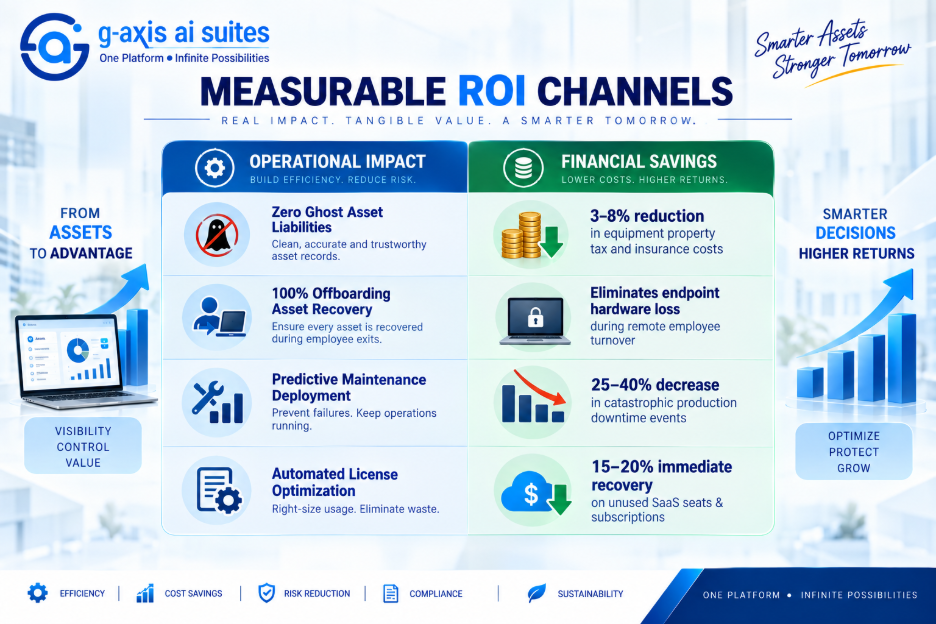
- Elimination of Unnecessary Capital Expenditure: When a department requests four new high-performance laptops or an emergency air compressor, managers review real-time availability across all branches. Idle assets in another facility can be redeployed immediately, eliminating redundant procurement spend.
- Rapid, Stress-Free Regulatory Audits: Instead of deploying teams for weeks of frantic physical counting and manual reconciliation during statutory audits, administrators generate cryptographically timestamped asset registers, chain-of-custody verification logs, and automated depreciation books in seconds.
- Protection of Intellectual Property & Enterprise Security: By ensuring every machine connecting to corporate systems is cataloged, monitored, encrypted, and immediately recovered upon employee departure, the organization removes major security blind spots that often lead to enterprise data breaches.
9. Frequently Asked Questions (Technical & Operational)
How does g-asset handle hybrid and permanently remote workforces?
For distributed workforces, the platform provides self-service verification workflows via its mobile portal. Remote employees periodically complete automated asset verification: the camera scans the secure QR code on their device, matches internal hardware parameters, records GPS/network location tags, and logs verifiable custody without requiring the equipment to return to a physical corporate office.
What is the operational difference between CMMS and EAM?
A CMMS (Computerized Maintenance Management System) focuses specifically on maintenance operations—logging work orders, managing technician tasks, tracking spare part inventories, and recording equipment repairs.
An EAM (Enterprise Asset Management) system provides a comprehensive, whole-life framework. It encompasses everything a CMMS does, but connects those maintenance records directly to procurement contracts, accounting depreciation books, lifecycle cost engineering, statutory regulatory compliance, and final scrap disposal. g-asset operates as a complete, unified EAM platform.
How does the system handle asset depreciation across different tax regimes?
The financial engine within the g-axis AI suite maintains concurrent accounting books. You can configure one depreciation profile aligned with local corporate tax regulations (e.g., accelerated written-down value methods for tax deductions) while concurrently maintaining straight-line amortization schedules on an operational ledger matching global financial reporting standards (such as IFRS or US GAAP).
What happens if an asset tag is damaged, scraped off, or vandalized?
Industrial environments are demanding. When an asset label is damaged, operators pull up the asset profile using its secondary attributes—such as its permanently stamped chassis serial number, MAC address, or assigned physical room.
Authorized administrators then select the “Re-Tag Asset” function in g-asset, scan a new physical tag, and link it to the existing historical record. All previous service tickets, depreciation schedules, and custody logs remain fully preserved.
10. Summary Blueprint: The Path to Asset Mastery
Operating a modern, competitive enterprise without centralized, real-time asset intelligence is like flying blind in severe weather. The operational and capital costs of spreadsheet-based management—ghost assets, surprise equipment breakdowns, lost hardware, and failed compliance checks—are an unnecessary drag on growing businesses.
By unifying the physical identification of equipment with the dynamic intelligence of the g-axis AI suite, g-asset transforms asset management from a passive recording task into a proactive engine of operational efficiency.
Every laptop, every machine tool, every vehicle, and every software license is tracked, maintained, accounted for, and optimized from the moment it enters your enterprise to the day it is retired.
Stop tracking your mission-critical capital investments on outdated spreadsheets. Build an accountable, audit-proof, and autonomous enterprise asset tracking system with g-asset.